
What parts of the brain are stimulated by cochlear implants in children with one deprived ear?
Karen Gordon – karen.gordon@utoronto.ca
Archie’s Cochlear Implant Laboratory, The Hospital for Sick Children, University of Toronto, The Hospital for Sick Children, TORONTO, ON, M5G1X8, Canada
Additional Authors – Anderson, C., Jiwani, S., Polonenko, M., Wong, D.D.E., Cushing, S.L., Papsin, B.C.
Additional Links
SickKids: https://lab.research.sickkids.ca/archies-cochlear-implant/
Hear Here Podcast: https://linktr.ee/hearherepodcast
Popular version of 3aPP5 – Non-auditory processing of cochlear implant stimulation after unilateral auditory deprivation in children
Presented at the 184 ASA Meeting
Read the abstract at https://doi.org/10.1121/10.0018669/
Decades of research have shown that hearing from only one ear in childhood should not be dismissed as a “minimal” hearing problem as it can impair language, cognitive, and academic development. We have been exploring whether there are effects of unilateral hearing on the developing brain. A series of studies has been done in children who have one deaf ear and who hear from the other side through a normal or typically hearing ear, a hearing aid, or a cochlear implant. We record electrical fields of brain activity from electrodes placed on the surface of the head (encephalography); we then calculate what parts of the brain are responding.
The findings show that auditory pathways from the hearing ear to the auditory cortices are strengthened in children with long term unilateral hearing. In other words, the hearing brain has developed a preference for the hearing ear. As shown in Figure 1, responses from the better hearing ear were also from areas of the brain involving attention and other sensory processing. This means that areas beyond the auditory parts of the brain are involved in hearing from the better ear.
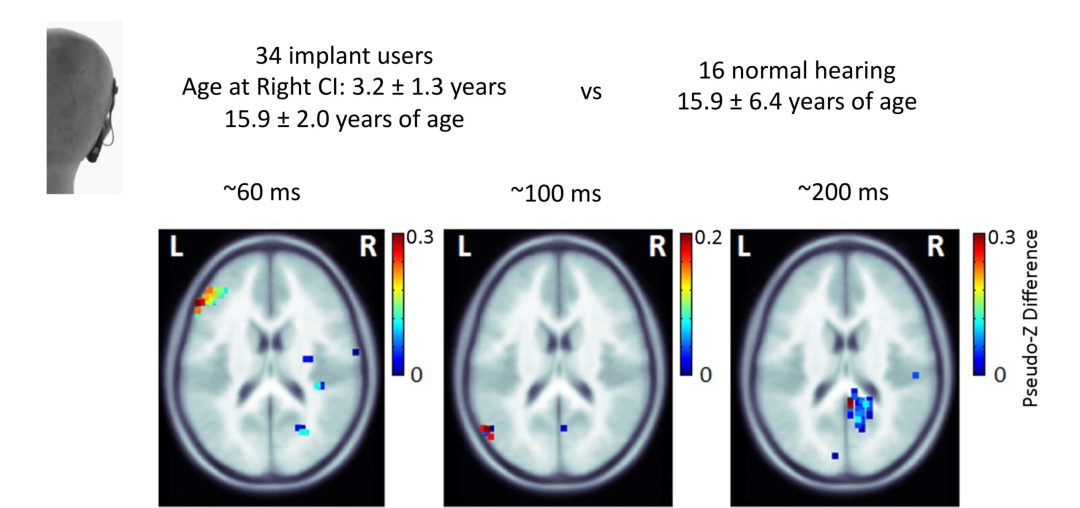
Figure 1 legend: Cortical areas abnormally active from the experienced ear in children with long periods of unilateral cochlear implant use include left frontal cortex and precuneus.Adapted from Jiwani S, Papsin BC, Gordon KA. Early unilateral cochlear implantation promotes mature cortical asymmetries in adolescents who are deaf. Hum Brain Mapp. 2016 Jan;37(1):135-52. doi: 10.1002/hbm.23019. Epub 2015 Oct 12. PMID: 26456629; PMCID: PMC6867517.
We also asked whether there were brain changes from the ear deprived of sound in children. This question was addressed by measuring cortical responses in three cohorts of children with unilateral hearing who received a cochlear implant in their deaf ear (single sided deafness, bilateral hearing aid users with asymmetric hearing loss, and unilateral cochlear implant users). Many of these children showed atypical responses from the cochlear implant with unusually strong responses from the brain on the same side of the deaf implanted ear. As shown in Figure 2, this unusual response was most clear in children who had not heard from that ear for several years (Figure 2A) and was already present during the first year of bilateral implant use (Figure 2B).

Figure 2 legend: Cortical responses evoked by the second cochlear implant (CI-2) in children receiving bilateral devices. A) Whereas expected contralateral lateralization of activity is evoked in children with short periods of unilateral deprivation/short delays to bilateral implantation, abnormal ipsilateral responses are found in children with long periods of unilateral deprivation despite several years of bilateral CI use. Adapted from: Gordon KA, Wong DD, Papsin BC. Bilateral input protects the cortex from unilaterally-driven reorganization in children who are deaf. Brain. 2013 May;136(Pt 5):1609-25. doi: 10.1093/brain/awt052. Epub 2013 Apr 9. PMID: 23576127. B) Abnormal ipsilateral responses are also found throughout the first year of bilateral CI use in children with long periods of unilateral deprivation/long delays to bilateral CI. Adapted from Anderson CA, Cushing SL, Papsin BC, Gordon KA. Cortical imbalance following delayed restoration of bilateral hearing in deaf adolescents. Hum Brain Mapp. 2022 Aug 15;43(12):3662-3679. doi: 10.1002/hbm.25875. Epub 2022 Apr 15. PMID: 35429083; PMCID: PMC9294307
New analyses have shown that this this response from the CI in the longer deaf ear includes areas of the brain involved in attention, language, and vision.
Results across these studies demonstrate brain changes that occur in children with unilateral hearing/deprivation. Some of these changes happen in the auditory system but others involve other brain areas and suggest that multiple parts of the brain are working when children listen with their cochlear implants.